Showing posts with label Los Angeles County. Show all posts

Monday, January 12, 2015

NAMI Westside Los Angeles: Consolidation Means MH Dilution

On Thursday, there was an announcement that supervisor Antonovich is proposing to consolidate the three health agencies: Dept. of (1) Mental Health (2) Public Health, and (3) Health Services, in LA County into one agency.  This will be heard at the Supervisor's meetingnext Tuesday (1/13/15).

The problem with this action is that consolidating the three agencies will dilute the power of the Dept. of Mental Health.  By combining the agencies, less of a priority will be placed on mental health than with a single focused agency like the DMH.  Also, employees with less experience in mental health from outside of the DMH may end up holding positions involving mental health issues when the agencies are combined.  It is being pitched as a way to solve bureaucracy, but in fact it will break a system that has put a priority on mental health.  Please call your district supervisor and let them know how you feelbefore 1/13/15:
*If you're not sure which to call, just look it up here or just pick one or two.

First District
Hilda L. Solis (213) 974-4111
Second District
Mark Ridley-Thomas (213) 974-2222
Third District (westside)
Sheila Kuehl (213) 974-3333
Fourth District
Don Knabe (213) 974-4444
Fifth District
Michael D. Antonovich (213)974-5555

Monday, October 20, 2014

News Article: Prison for Fun and Profit

At the beginning of the 1980s there were no privately-operated adult correctional facilities in the United States. As of 2009, more than 129,300 state and federal prisoners were housed in for-profit lock-ups. Prison privatization has become an acceptable practice and the private prison industry is now a multi-billion dollar business. How did this drastic expansion of incarceration-for-profit occur, and more importantly how has it rearranged the criminal justice landscape?

Read Full Article: Prison for Fun and Profit

Tuesday, August 12, 2014

Robin Williams dead at 63: Actor’s battle with severe depression spotlights celebrities’ mental illnesses

Hopefully his passing will provide a spotlight on treatment and resources for those suffering from mental illness. It is such a huge issue that is not publicized enough in my opinion.


From the NYDAILY NEWS:
Robin Williams talked about his battle with depression, as well as years of drug and alcohol addiction, in interviews years before his death. The actor was found dead in his California home Monday.


The actor’s battle with depression puts a spotlight on his famous friends, including Christopher Reeve and Jonathan Winters, and other celebrities who had experiences with extreme depression.


http://www.nydailynews.com/entertainment/gossip/robin-williams-battle-depression-spotlights-celebrities-mental-illnesses-article-1.1900493

Tuesday, May 27, 2014

Recent statement from Lou Vince at DAA regarding mental health

Recent statement from Lou Vince at DAA regarding mental health:

Another major problem in the County jails is the mental deterioration of prisoners with mental illnesses who are receiving little to no services while incarcerated. This problem is directly linked to violence in the jails.
The Los Angeles County jail system has been described by many experts and commentators as the largest psychiatric hospital in the country. The popular social movement of “De-institutionalization” of some years ago has turned into what some mental health experts now term “trans-institutionalization” because our society has transferred the population that once resided in psychiatric hospitals and mental institutions to our jails and prisons. 64% of jail inmates suffer from a significant mental health problem.
According to the opinions of Dr. Terry A. Kupers in a 2008 ACLU report, few inmates in the L.A. County jails were receiving mental health treatment and about 350 per 2,000 inmates were receiving only medications while being subjected to severe overcrowding or isolation but no mental health programming.
Additionally, in tours of Men’s Central Jail, Twin Towers, and the Inmate Reception Center Kupers encountered a significant number of inmates who were either never diagnosed or were discharged from the caseload and transferred from mental health housing, administrative segregation, or disciplinary housing into the general population.
The connection between jail violence and mental illness should be obviously clear. Add jail overcrowding and you have a recipe for increased rates of violence, psychiatric breakdown, suicide, a loss of impulse control, temper flares, and increased noncompliance with rules and regulations.
Also of great concern was the fact that it was found that these mentally-ill inmates were rarely seen by psychiatrists and were being managed by Deputy Sheriffs who had no training in handling psychiatric patients. Deputies react to behaviors exhibited by the mentally ill. They become gruff, which is interpreted by the inmates as being “disrespected” and they, in turn, become angry. Their anger can and does result in being punished and so the anger escalates. Deputies react and so the cycle continues. As your next Sheriff, I would end this cycle!
As Sheriff, I would lobby the County Supervisors to mandate the Department of Mental Health to evaluate the need for substance abuse and mental health services among pre-trial and sentenced offenders, in both the incarcerated and community-supervised population, and develop a plan to fund and provide such treatment and services both in the correctional facilities and the community.

"Mental Health Crisis" series: Mental Illness Takes Toll

Antelope Valley
"Mental Health Crisis" series

"Mental Illness Takes Toll" by Andrew Clark

Click on image to enlarge

"Mental Health Crisis" series: System Overwhelmed

Antelope Valley
"Mental Health Crisis" series

"AV Mental Health Officials Seek Funds" by Andrew Clark


Click on image to enlarge

Click on image to enlarge

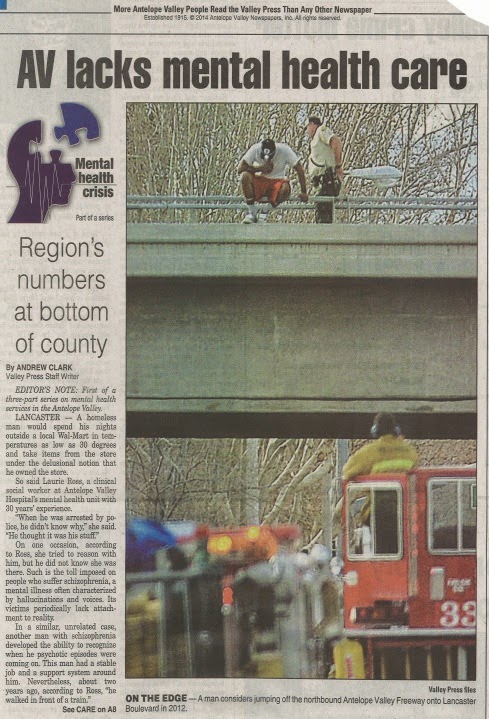
"Mental Health Crisis" series: Antelope Valley Lack Mental Health Care

Antelope Valley Press
"Mental Health Crisis" series

"Region's Numbers at Bottom of County" by Andrew Clark

 Click photos to enlarge


 Click photos to enlarge